
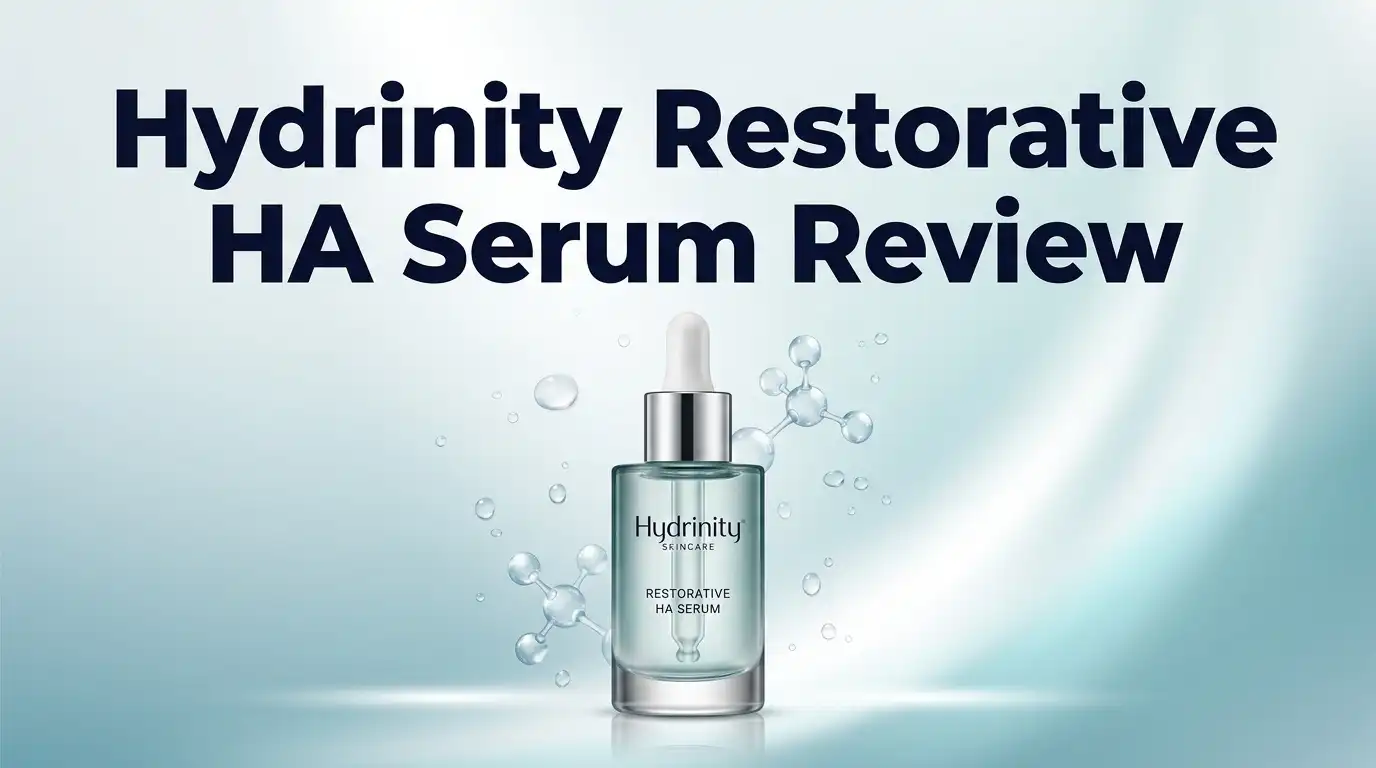
Hydrinity Restorative HA Serum Review 2026: Worth It?
Dehydrated skin that stings after a shower, flushes at dinner, and still looks dull under makeup is a frustrating combination. Most hyaluronic acid serums add water and stop there.
Hydrinity built its Restorative HA Serum around a different promise: calm the skin down while it hydrates, so a compromised barrier gets a chance to rebuild.
At $120 for one ounce, that promise deserves scrutiny. I used this serum daily for six weeks, tracked how my skin behaved, and read through hundreds of buyer comments to separate the marketing from the measurable.
In a Nutshell
- Hydration quality is genuinely high. This is not a thin, tacky HA layer. The Supercharged Hyaluronic Acid sits at the second slot in the ingredient list, and skin stays comfortable for hours rather than tightening at hour three.
- Redness control is the real headline. Between bisabolol, ginger root extract, and Agastache mexicana, my flushing across the cheeks softened noticeably by week three. Rosacea-prone buyers report the same pattern repeatedly.
- The texture is a silicone-slip gel-cream, not a watery drop. Dry, sensitive, and post-procedure skin will love it. Very oily or filament-prone skin may find it too cushioned.
- The clinical numbers come with a footnote. The 280% and 200% day-one figures were measured using the serum paired with Hyacyn Active mist, not the serum alone.
- Breakout reports exist and are consistent enough to matter. Several acne-prone users, including estheticians, report congestion. Dimethicone ranks third in the formula.
- Price is the main obstacle. Third-party Amazon listings fluctuate wildly, so verify size and seller before buying.
What Hydrinity Restorative HA Serum Actually Is

Last update on 2026-08-10 / Affiliate links / Images from Amazon Product Advertising API Some of the links on this website are affiliate links, which means that at no additional cost to you, I earn a commission if you click through and make a purchase. I only recommend products and services that I believe will add value to my readers. Thank you for your support!
This is a medical-channel hydrating serum sold mainly through dermatology offices, med spas, and licensed estheticians. Hydrinity is a Florida-based brand built around its patented PPM⁶ Technology™.
The pitch is straightforward. A high-purity hyaluronic acid delivers moisture at the surface and slightly below it, while peptides and antioxidants handle inflammation and free radical damage.
The brand positions it as safe for all skin types, including sensitive and post-procedure skin. That last category matters. This serum shows up constantly in aftercare protocols for microneedling, lasers, and chemical peels.
It is fragrance-free, alcohol-free, non-comedogenic by brand testing, and free of petrolatum. One bottle holds 1 fl oz and retails at $120 direct.
The formula is not a treatment serum in the retinoid or acid sense. It contains no exfoliants, no vitamin C, and no retinol. Its entire job is hydration plus calm.
Unboxing, Packaging, And First Impressions
The box is clean white and clinical, with the product name in a simple sans-serif and almost no marketing copy. It feels like something a nurse hands you, not something you grab at Sephora.
Inside sits a heavy frosted bottle with a pump. The weight is the first surprise, and several buyers mention it in reviews.
The pump is the best functional decision here. Hyaluronic acid and peptides degrade with repeated air and light exposure, and a sealed pump protects both far better than a dropper.
Dose control is accurate. One full press gives a pea-sized amount, which covers face and neck with a little effort.
My one packaging complaint is visibility. The opaque bottle means you cannot see the fill level, so the product runs out with no warning.
Priming took three presses on first use. Nothing rattles, nothing leaks, and the cap seats firmly for travel.
Texture, Scent, And Absorption
This is where expectations need adjusting. If you picture a slippery, water-thin HA drop, this is not that.
The serum is a cushioned gel-cream with real body. It sits somewhere between an essence and a light moisturizer, and it feels almost silky between the fingers thanks to dimethicone and polysilicone-11.
Scent is technically absent. There is no added fragrance, but the base carries a faint plastic-adjacent smell that some buyers dislike. It vanishes within seconds of application.
Absorption takes roughly forty seconds on damp skin. It leaves a soft matte-satin finish rather than a sticky film, which is unusual for an HA product at this concentration.
Makeup sits well over it. I had no pilling under mineral sunscreen or a silicone primer, which surprised me given the silicone content.
Oily skin will register it as slightly rich in summer. Dry and dehydrated skin will likely want a second layer.
Top 3 Alternative for Hydrinity Restorative HA Serum
SkinMedica HA5 Rejuvenating Hydrator

Last update on 2026-08-10 / Affiliate links / Images from Amazon Product Advertising API Some of the links on this website are affiliate links, which means that at no additional cost to you, I earn a commission if you click through and make a purchase. I only recommend products and services that I believe will add value to my readers. Thank you for your support!
iS Clinical Hydra-Cool Serum


Last update on 2026-08-10 / Affiliate links / Images from Amazon Product Advertising API Some of the links on this website are affiliate links, which means that at no additional cost to you, I earn a commission if you click through and make a purchase. I only recommend products and services that I believe will add value to my readers. Thank you for your support!
Neocutis Hyalis+ Intensive Hydrating Serum

Last update on 2026-08-10 / Affiliate links / Images from Amazon Product Advertising API Some of the links on this website are affiliate links, which means that at no additional cost to you, I earn a commission if you click through and make a purchase. I only recommend products and services that I believe will add value to my readers. Thank you for your support!
Inside The Formula: What The Ingredients Do
The list is short by medical-grade standards, and the ordering is honest. Hyaluronic acid ranks second, immediately after water, which is rare at any price point.
Dimethicone and glycerin follow. Glycerin pulls water in; dimethicone locks it down and creates the silky feel.
Nicotiana benthamiana hexapeptide-40 sh-polypeptide-76 is the peptide doing the structural work. It is a plant-expressed peptide linked to elasticity and firmness support.
The soothing group is where this formula earns its name. Bisabolol from chamomile, ginger root extract, and Agastache mexicana all target redness and inflammation from different angles.
Kakadu plum (Terminalia ferdinandiana) supplies antioxidant support and one of the highest natural vitamin C concentrations on record, though at this position it is a supporting player.
Nannochloropsis oculata microalgae extract rounds it out with firming and nourishing claims. Preservation runs on phenoxyethanol and ethylhexylglycerin, a gentle and well-tolerated pairing.
No essential oils. No drying alcohols. No fragrance.
PPM⁶ Technology And The Clinical Claims Translated
Hydrinity leads with three numbers: a 280% increase in accelerated healing on day one, 200% firmer-looking skin and less visible pores on day one, and 61% improvement in smoothness within one week.
Read the fine print. Those results came from patient-observed data using the Restorative HA Serum combined with Hyacyn Active, the brand’s hypochlorous acid mist.
That does not make the numbers false. It makes them numbers for a two-product system, not a single bottle.
PPM⁶ refers to the brand’s purity and molecular precision standard for its hyaluronic acid. The claim is that a purer, more precisely sized HA penetrates better and acts as a delivery vehicle for the peptides riding alongside it.
Independent published trials on this specific technology are not publicly available. What exists is internal clinical data and a large volume of professional-channel feedback.
My honest translation: the formula performs well, and the day-one percentages are best treated as directional marketing rather than a guarantee.
Six Weeks On Dehydrated, Redness Prone Skin
Week one delivered comfort, not drama. My skin stopped feeling tight by mid-afternoon, which had been a daily annoyance.
By week three, the change I actually cared about arrived. The persistent flush across my cheeks and nose dropped in intensity, and my skin looked one uniform color in morning light.
Texture improvement followed around week four. Fine dehydration lines under the eyes and around the mouth softened, though nothing structural changed.
I used it after a microneedling session in week five. Zero stinging, and the sandpaper phase resolved faster than my usual routine allows.
What it did not do: fade sun spots, shrink pores in any lasting way, or reduce an established wrinkle. It is a hydrator with an anti-inflammatory backbone, and it stays in that lane.
Buyer feedback matches this arc. The recurring words across hundreds of reviews are soft, hydrated, calm, and less red, with rosacea and post-surgical scarring mentioned often.
Who This Serum Is Not For
This is the part most reviews skip. The negative feedback pattern is specific and worth taking seriously.
Acne-prone and congestion-prone skin carries real risk here. Multiple long-term users, including practicing estheticians, report breakouts from both Hydrinity HA serums despite the non-comedogenic label.
Dimethicone in the third position is the likely culprit for that subset. Silicones do not clog pores for most people, but they trap whatever is underneath them, and some skin objects.
Very oily skin in humid climates may find the finish too occlusive for daytime. A lighter, silicone-free HA will serve you better.
Anyone chasing brightening, exfoliation, or wrinkle correction should look elsewhere entirely. There is no active in here that addresses pigment or collagen remodeling in a meaningful way.
Budget-conscious buyers should also pause. At roughly $120 per ounce, the cost per month is significant for a product that does one job.
Pros And Cons
Pros
- Hyaluronic acid sits second in the ingredient list, which is unusually high placement and reflects genuine concentration rather than a token inclusion.
- Redness and inflammation control is the standout benefit, backed by bisabolol, ginger root, and Agastache mexicana working together.
- Excellent post-procedure tolerance. It applies over microneedled, lasered, or freshly peeled skin without stinging, which is why clinics stock it.
- Fragrance-free, alcohol-free, and essential-oil-free, removing the three most common irritant categories for reactive skin.
- Airless pump packaging protects the peptides and HA from oxidation far better than dropper bottles.
- Layers cleanly under sunscreen and makeup with no pilling in my testing.
Cons
- Price is steep at $120 per ounce, and the serum does not multitask beyond hydration and calming.
- Breakout reports from acne-prone users are consistent enough to be a genuine pattern, not isolated noise.
- The headline clinical percentages were generated with a second product, which weakens them as standalone evidence.
- Opaque bottle hides the remaining product, so it empties without warning.
- Texture reads slightly rich for very oily skin in warm weather.
- Amazon third-party pricing and sizing are inconsistent, raising authenticity questions.
Price, Packaging, And Value Per Drop

Last update on 2026-08-10 / Affiliate links / Images from Amazon Product Advertising API Some of the links on this website are affiliate links, which means that at no additional cost to you, I earn a commission if you click through and make a purchase. I only recommend products and services that I believe will add value to my readers. Thank you for your support!
Direct from Hydrinity, one ounce costs $120. Professional retailers price it in the same range, occasionally a few dollars lower.
Amazon is a different story. Listings appear under generic seller names at wildly varied prices for 5 ml, 15 ml, and full-size bottles, and the per-ounce math frequently exceeds the brand’s own pricing.
My recommendation is practical rather than promotional. Verify the size, the seller, and the batch before purchasing through any marketplace listing.
On usage economics, two pumps twice daily gave me about ten weeks per bottle. That works out to roughly $1.70 per day.
Compared with SkinMedica HA5 or Neocutis Hyalis+, the pricing is competitive within the medical-grade tier. Compared with a drugstore HA serum, it is indefensible on price alone.
The value case rests entirely on whether inflammation and barrier fragility are your primary concerns. If they are, the calming performance justifies the spend. If they are not, you are paying a premium for hydration you can source cheaper.
Final Verdict
Hydrinity Restorative HA Serum does what a restorative serum should do. It hydrates deeply, it calms visible redness, and it behaves impeccably on skin that has just been through a clinical procedure.
It is not a miracle bottle. The day-one clinical percentages need context, and the formula will not correct pigment, texture damage, or established lines.
The buyer who gets the most from it has dehydrated, sensitive, rosacea-prone, or post-procedure skin and has already tried cheaper HA serums without relief.
The buyer who should walk away is acne-prone, very oily, or shopping for a single serum that handles everything.
Would I repurchase? Yes, but seasonally. In winter and after any in-office treatment, it earns its place.
For a summer routine on balanced skin, I would reach for something lighter and less expensive. That is not a criticism of the formula. It is a recognition that this serum solves a specific problem extremely well and ignores everything else.
Expert FAQs
Can I use Hydrinity Restorative HA Serum with retinol?
Yes, and this is one of its strongest use cases. Long-term users specifically cite it as the product that keeps retinol irritation manageable.
Apply the serum first on damp skin, let it settle, then follow with your retinoid. You can also buffer in reverse if your skin is highly reactive.
Is this serum safe immediately after microneedling or laser treatment?
The brand tests it for post-procedure use, and clinics routinely include it in aftercare protocols. Reviewers report applying it directly after microneedling with no stinging.
Always follow your provider’s specific instructions first. Protocols vary by procedure depth and practitioner.
Will it break out acne-prone skin?
It might. The label reads non-comedogenic, but a recurring subset of acne-prone users reports congestion and breakouts.
Dimethicone ranks third in the formula and is the most likely trigger for that group. Request a sample from a provider before committing to a full bottle.
How does it compare to SkinMedica HA5?
HA5 uses a five-form hyaluronic acid blend and leans toward smoothing and plumping. Hydrinity leans toward calming and barrier repair.
Several reviewers who used both describe Hydrinity as absorbing better and reducing redness more effectively. HA5 tends to feel richer on the skin.
Does it need the Hyacyn Active mist to work?
No, but the clinical data was generated with the pairing. The mist preps skin and the serum seals in hydration afterward.
The serum performs well alone in my testing. Expect the brand’s fastest quoted results only when you use both.
How long before results appear?
Hydration and comfort register within the first few days. Redness reduction took about three weeks in my case.
Texture improvements arrived around week four. Give it a full eight weeks before judging.
Is it suitable for pregnancy?
The formula contains no retinoids, no salicylic acid, and no hydroquinone, which are the usual concerns. That said, I am not a medical professional.
Confirm with your obstetrician or dermatologist before adding any product during pregnancy or breastfeeding.

Hi i’m Mia Jenkins a fashion trend expert with a passion for self-expression, skincare, haircare and makeup. With a keen eye for style and a deep understanding of the latest trends and beauty products.
